Wednesday, March 9, 2022

The Main Students of Seiko Higa

I spoke before about some of the notable students of Chojun Miyagi. Today I thought it would be interesting to go over Seiko Higa's notable and senior students. Interestingly, many of his students were about the same age as Miyagi's, if not a little older. 

One of the best sources for finding out who Higa's students were is the memorial book that was published for him and his son Seikichi Higa by the Goju-Ryu Kokusai Karate Kobudo Renmei (Higa's organization). Near the back, there's a lineage chart showing his key students: 


Right to left, the names are: Juei Tamaki 玉城 寿英 1905-1997, Kanki Izumikawa 泉川 寛喜 1908-1967, Choboku Takamine 高嶺 朝睦 1908-2006, Seiko Fukuchi 福地 清幸1919-1975, Seikichi Toguchi 渡口 政吉 1917-1998, Yohena Tomoshige 饒平名 知繁 1923, Seikichi Higa 比嘉 世吉 1927-1999, Choshin Ishimine 伊志嶺 朝信 1931-1996, Choyu Kiyuna 喜友名 朝有 1931, Eikichi Fukumoto 福元 英吉 1936-1995, Eiki Kurashita 蔵下 英喜 1941, Yuzuro Oshiro 大城 譲 1945, Seiki Gibo 宜保 成喜 1939.

The only ones from this list that are still living are Choyu Kiyuna, Eiki Kurashita, and Seiko Gibo. 


Sunday, March 6, 2022

Seienchin Kata

Seienchin (Seiunchin) is one of the core Goju-Ryu kata and usually one of the early ones you'll learn. Typically this comes after Saifa, although the Meibukan seems to have it later in their curriculum. With most of the Goju-Ryu kata, there's not a whole lot of historical information that's been published and most of it boils down to "Kanryo brought in back from China". 

I thought today I'd share a translation I did on Seienchin from Akio Kinjo's book, Karate Denshin Roku. Kinjo trained with Seiko Higa and Chosin Ishimine before later going to China to study various kung fu styles and the origins of karate. I still think his book is probably one of the most detailed but sadly it's never received an English translation. 

セイインチン (青鷹戦) Seienchin (Blue Hawk Battle)

This kata is a kata of Goju Ryu that Kanryo Higaonna has transmitted, but after the transmission, it has been Okinawanized. The pronunciation has changed slightly depending on the kai-ha (school), such as `seiinchin'`sēenchin' `seiyunchin' and so on.  「セイインチン」「セーエンチン」 「セイユンチン」

In this kata as well as other kata before the war, they were expressed in katakana characters, but after the end of the war, various types of kanji are used.

Depending on the kai-ha the kanji: 「清栄戦」「征遠鎮」「制引戦」「制引鎮」can be used. 

Correctly it is "青鷹戦" and " Chieiinchin" 「チエイインチン」 in Fukkien-Go.

It is a kata created by incorporating the conflict and movements of the "hawk".

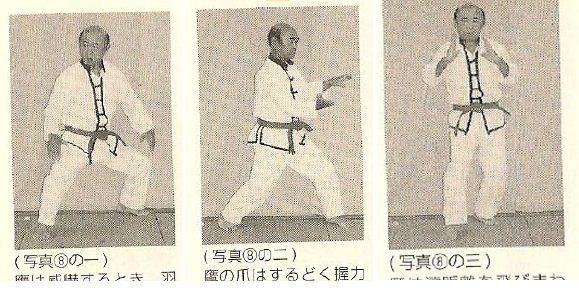
An analysis of the contents of the Goju Seienchin kata shows the first photograph is a posture in which the wings are spread and inflated to intimidate the opponent when confronted with a strong enemy. The second figure is a posture in which the opponent’s forearm is gripped by a claw. The third picture is the last technique of Goju Ryu Seienchin, This is exactly the appearance of a hawk after its activity, landing on a tree branch and resting with a cool breeze by opening the wings to lower the body temperature, which means the end of the kata.

Seienchin postures from Kinjo's book

So, for the most part, Akio Kinjo believes this was a hawk related kata. As a side note, this kata also seems to have the most variety in how it's written/spelled.  In my lineage of Goju (Higa Izumikawa) we say Seienchin, others sometimes say Seiunchin or Seiyunchin. 


Saturday, January 1, 2022

Sosui Ichikawa Biography (Goju Kensha Kyohan 1977)

Below is a translation of a short biography written on Sosui Ichikawa sensei by Tadahiko Ohtsuka sensei in the Goju Kensha Kyohan. Ichikawa sensei was one of the senior students of Kanki Izumikawa sensei from the Senbukan who introduced the Goju-Ryu of Seiko Higa sensei to the mainland. 

Born in Shitaya, Taito-ku, Tokyo (Taisho 12 August 29). Current address: 3-11 Higashi-Ueno, Taito-ku Sosuikan Karate Dojo. 

While attending the former Komagome Junior High School, he received karate instruction from a Chinese literature teacher, Nakasone sensei. After graduating, he volunteered to join the Navy. Mr. Kinjo from Okinawa was enrolled as a subordinate, and both worked hard at training.

Right to Left, Sosui Ichikawa, Kanki Izumikawa,
Hiroshi Kinjo, Tsutomu Takato 

After the end of the war, in showa 21 (1946), a club was formed at Nishimachi Elementary School in Taito Ward. In showa 22 (1947), he heard that there was a karate dojo in Kawasaki City, Kanagawa Prefecture. Going in kind to Kanki Izumikawa sensei, kancho of the Senbukan. After the general license was received in showa 25 (1950), he established the present Sosuikan in showa 27 (1952).

Currently, he is the Nihon Karate-do Renmei Kaicho, Sosuikan Kancho and also active as a judo therapist (bonesetter).  A teacher who never stops hoping to become stronger, the school of  Ichikawa Sosui sensei is on the way to prosperity.

Sosui Ichikawa Suparinpei
enbu

.


Thursday, July 8, 2021

Iken Tokashiki Okinawa Times July 4th 2021

The recent weekly karate article from the Okinawa Times featured Iken Tokashiki sensei. He's the founder of the Gohaku Kai which combines the Tomari Te of Seiyu Nakasone and Goju-Ryu of Seiko Fukuchi. Below is a translation of the article: 

Iken Tokashiki Kaicho (81) = Hanshi 10th Dan = of the "Okinawa Goju-Ryu Tomari Te Association (Gohaku Kai)", a school that combines Goju-Ryu and Tomari Te, received guidance from his predecessors, karate experts. While repeating rigorous training, he is focusing on the succession and development of the two schools.

Tokashiki sensei, 
chairman of the
Gohaku Kai

He was born in Naha City. He grew up listening to the heroic stories of karate ka from his father, who was an actor in Okinawa plays and was familiar with the history and culture of Okinawa. "I was told that boys have to practice martial arts," he recalls his childhood memories.

I joined the karate club in junior high school and started on the path of karate do. Four years later in 1957, he was allowed to begin training with Seiyu Nakasone sensei, a karate expert with a close relationship with his father.  Mr. Nakasone was a successor to Kosaku Matsumora (1829-98), who is known as the ancestor of Tomari Te, but had no students for many years.

Seeing his own hand with a callus, he felt that he was training. I was asked "Do you want to do karate?" At first, the training was just meditation, and then severe training began. It`s said that martial arts practitioners must pay attention to their daily behavior and words and deeds, saying that they must respect etiquette.

Tomari Te master Seiyu Nakasone sensei
in the middle

Sensei would say karate do is the martial art of a person of noble character. Strengthen your body and protect yourself. I was told that the essence of karate is not to become belligerent and avoid unnecessary conflict.

Under Mr. Nakasone, I came to want to learn modern karate teaching methods while practicing traditionally. In 1967, with the permission of Mr. Nakasone, he joined the Senbukan Goju Ryu dojo of Seiko Fukuchi, who had a close relationship with Nakasone.

Sensei (*Referring to Fukuchi now) always had the motto that attack and defense are one.  At the Fukuchi dojo I was assigned to be a shihan dai and started teaching. After practicing at the Fukuchi Dojo, Mr. Fukuchi hoped to teach Tomari Te with the permission of Mr. Nakasone.

After Mr. Fukuchi died, Mr. Tokashiki became the second chairman of Senbukan in 1975. In 1976, he received the signboard of Matsumora ha seishinkan as the successor to Mr. Nakasone who was old.  In this way, he inherited and developed the two schools, and in 1982 he established a new school, "Okinawa Goju-Ryu / Tomari Karate do Promotion Association (Gohaku Kai)", which combines Goju-Ryu and Tomari Te. Four years later, the name was changed to "Okinawa Goju-ryu / Tomari Karate do Association" and the style name (ryuha) name was changed to "Gohaku Ryu".

Goju-Ryu master, Seiko 
Fukuchi sensei.

"The association was established to inherit and develop the world-class traditional Okinawan karate. I have inherited the teachings of Nakasone and Fukuchi sensei, and have continued with the idea that I must teach both, "he recalls.

Currently, his oldest son, Tadao (55), has taken over as director and teaches his students, but Tokashiki continues to practice at the dojo even now as chairman. He is also devoting himself to research, and he is eager to acquire the skills and knowledge of traditional karate, such as holding a workshop once a year where about 30 executives from inside and outside the prefecture gather.

Tadao said “Kaicho (referring to Iken) is a person above the clouds”.  (*Translators Note = This means something like “out of my league” in English. He has such a high level of skill he far above and unreachable) I can’t easily imitate his movement (ugoki) and body timing while teaching.

Chairman Tokashiki said, "I am reminded what my teacher taught me as I move my body during training. I hope that I will continue to inherit the wonders of the two schools and techniques."


Tuesday, June 15, 2021

Who Were the Senior Students of Chojun Miyagi?

When people talk about the students of Chojun Miyagi, Seiko Higa, Meitoku Yagi, Seikichi Toguchi and Eiichi Miyazato are usually the main ones that come to mind. It might come as a surprise to learn Miyagi had more than a dozen other senior students, although as most of them didn’t open schools they are much less known. Despite this, they did still influence Goju-Ryu in numerous ways.

While Goju is often split into “pre-war” and “post-war” versions, I’d say you could group the pre war into two sperate categories too. 

Earliest Students 

These would be the very first people that trained with Chojun Miyagi. This is the first group of his students and the most senior. The key individuals here would be Seiko Higa, Hohitsu Gushimiyagi, Jinsei Kamiya, Jinan Shinzato, Keiyo Madambashi, Genkai Nakaima, Nanjo Kiju and Tatsutoku Sakiyama.

Chojun Miyagi with Seiko Higa, Kenwa Mabuni,
Juhatsu Kiyoda, Jinan Shinzato, Keiyo 
Madambashi, Genkai Nakaima,
Nanjo Kiju and Tatsutoku Sakiyama. (1924)

There might be a few new names on there, or at least some you didn’t often hear about. Higa of course needs no introduction, he originally trained with Kanryo himself. After his death it was natural to continue training with his senpai Chojun Miyagi. He’s also the only one from this group that opened a school and went on to teach students of his own.

Hohitsu Gushimiyagi was another student of Kanryo Higashionna. He remained a life long friend of Chojun Miyagi. In the memorial picture for Chojun Miyagi, he can be seen sitting next to the portrait of Chojun Miyagi.

Jinsei Kamiya holds a very important role in Goju-Ryu history.  In addition to being a student of Miyagi, he was also a physician and close friend.  While Miyagi often gets the credit for developing the Junbi undo, he was greatly assisted by Jinsei Kamiya.  

Main Pre War Students 

Here we find some more familiar names like Meitoku Yagi and Seikichi Toguchi. It also includes Seiko Kina, Shunshin Furugen, Kiei Tomoyose, Jitsui Yogi and Seijin Nakamoto.

Seiko Kina was one of the first of this group to begin teaching. According to the Okinawa Karate Kobudo Jitten, he was running a dojo in Izumizaki-cho where Miyagi and Shinzato would occasionally visit as well.

Chojun Miyagi teaching to various students

Shunshin Furugen never opened a school but did teach several students of Miyagi’s other students. His specialty kata was Kururunfa, which he learned directly from Miyagi himself. He is known to have taught at least Zenshu Toyama and Masanobu Shinjo.

When Morio Higaonna founded the IOGKF in 1979, many of the names above became advisors to the organisation.

Post War Students

We now come to the final group of students. The most senior here was undoubtably Eiichi Miyazato. Others included Koshin Iha, Aniichi Miyagi, Chisen Bise, Seikichi Kinjo and Suichi Aragaki. After the passing of Chojun Miyagi almost all of the post war students remained closely associated with Eiichi Miyazato, at least for a period of time.

Miyazato continued teaching in the garden dojo, and when the location got too small due to the number of new students, the Jundokan dojo was built.

The Founding of the Goju-Ryu Shinko Kai

During Chojun Miyagi’s life time several of his students got together to form an organisation for the preservation and promotion of Goju-Ryu. The founding members were Genkai Nakaima, Seiko Higa, Jinsei Kamiya and Keiyo Madambashi. Chojun Miyagi was the first president of the organisation. After his death, Seiko Higa was the second president. The organisation would eventually evolve into the Okinawa Goju Kai.

A notice in the newspaper about the Shinkokai.
The four main members are listed.  

If you’re interested in more Goju-Ryu history, my book History and Stories of Goju-Ryu has much more detailed biographies of most of the individuals mentioned above, and many more: https://www.lulu.com/en/ca/shop/filip-konjokrad/history-and-stories-of-goju-ryu/paperback/product-1y8w9n86.html?page=1&pageSize=4


Wednesday, June 9, 2021

Kanbun Izumikawa: The Successor of Kanki Izumikawa

Kanbun Izumikawa was the oldest son of Kanki Izumikawa, born in Kawasaki city in 1942. From an early age he was absorbed in karate and learning the Senbukan Goju-Ryu from his father Kanki. It is typically the tradition for the firstborn son to succeed the father as the head of the school and he was being prepared for this role early on. Kanbun would have received a detailed instruction in the inner techniques and teachings of Goju-Ryu from his father.

In 1967, Kanki Izumikawa the shodai soke of the Senbukan passed away. Kanbun Izumikawa then became the second soke of the Senbukan and inherited his father’s teachings and legacy. Under his leadership the “Goju Ryu karate do Senbukan” was renamed to "Goju Ryu karate do Senbukai”.  According to his younger brother Katsuya, Kanbun was very serious about karate and practiced it strongly. He was committing to growing and expanding the Senbukai. Unfortunately, though, following the passing of their father, many of Kanki Izumikawa's senior students left and established their own organisations.

From 1963-1968 he had consecutive victories in kata competition at the All Nihon Karate-do Senshu Ken Taikai which was sponsored by the Nihon karate Do Rengokai. In 1973 he also travelled to the Senbukan branch dojo on Hawaii to teach as his father did before. In addition, each summer he would travel to Okinawa and train with Juei Tamaki who was a senior student of Seiko Higa and former dojo brother of his father Kanki Izumikawa. These annual visits went on for a period of ten years and were to further his understanding of the Seiko Higa lineage of Goju-Ryu. Kanbun also served as director of the Kawasaki Karate Association.

In 1982, sadly he succumbed to an illness and died at the young age of 39. His younger brother Katsuya Izumikawa who was his assistant instructor inherited the Senbukai as the third soke and continues to pass on the traditional Goju-Ryu teaching from his father and brother.

Kanbun Izumikawa 
Sanchin Kata


Saturday, May 8, 2021

Shuichi Aragaki Okinawa Times May 2019

The following is a translation of an interview with Shuichi Aragaki which appeared in the Okinawa Times May 2019 as part of their weekly feature on karate. There's some interesting information about the time he spent training with Chojun Miyagi. 

Shuichi Arakaki (90) = Urasoe City = who is a direct pupil of Chojun Miyagi (1888-1953), the founder of Okinawa Karate Goju-ryu, inherited the teachings of Chojun's later years and handed down Goju-ryu.  The saying of Miyagi sensei was do not hit people and do not be hit by people. "The important thing about karate is humble feelings and kindness."

Mr. Arakaki was born in Taiwan in 1929 and returned to Okinawa with his family in 1947 after the end of the war.  His grandfather, Ryuko was Chojun's first karate teacher. When Mr. Arakaki became interested in karate, Mr. Ryuko said, "I will guide you to Matsu (childhood name of Mr. Chojun)."

He became a disciple of Chojun Miyagi when he was 22 years old

At that time, Mr. Chojun had no disciples other than Mr. Anichi Miyagi, but when his first teacher, Mr. Ryuko, visited him, he thanked him and immediately allowed him to become a disciple. In 1951, Mr. Arakaki was 22 years old and Mr. Chojun was 63 years old.

As soon as I finished my work, I started going to Mr. Chojun's house in Mihara, Naha City. At first, I wasn’t allowed into the house,  I just took care of the surroundings such as cleaning the garden, drawing water from the well, and chopping (chopping wood?), but in reality, this is also part of the training. It is said that Mr. Chojun was dressed up and sat upright, watching the situation.  I can't say " please tell me". If you ask a question, you will be told, "you don't have enough hardship".  He was quiet and polite, but it was tough when it came to training. Mr. Arakaki is still in awe.

During the Sanchin practice, he was allowed to enter the house. Mr. Chojun looked at the movement of his legs and how to use his muscles, and gave guidance by hitting the bad points by hand. The struck shoulder would swell, and the thighs are squeezed during training. The size of the clothes didn't fit and I was in trouble.

Life and practice

Many dojos now have a fixed date and time for training, but at that time life itself was training. When passing through the stone wall road of Tsuboya, I struck the rugged rock surface with my bare hands to train them. I still remember the teaching that "if you take a day off, it will take three days to get it back."

On the other hand, when the training was over, he also showed a gentle side, saying, "Eat dinner." Mr. and Mrs. Chojun, Mr. Anichi, and Mr. Arakaki surrounded the table on a daily basis. I was told about karate, and before I got home late at night, I was told, "Walk in a bright place even if you take a detour at night."

Three years after the introduction, Mr. Arakaki moved to Tokyo to go on to higher education. It was a month later that Mr. Chojun's news arrived.

Mr. Arakaki says, "I've been taught not to tell people that I'm doing karate" because people started fights to test my skills and the number of enemies increased. In any situation, I faced it with karate, which was placed in the center of my mind and body, saying, "This is karate."

Guidance around the dojo

In Tokyo, he taught karate to fellow students and children in the neighborhood, and later served as a teacher at the dojo of Mr. Chojun's eldest son, Kei.  When he returned to Okinawa in 1972, he taught Mr. Anichi and his juniors. “I started to go around the dojo and teach because I thought that it was one of my responsibilities to spread what I learned from Mr. Chojun”.

Based on Mr. Chojun's teaching, "The important thing in doing karate is socializing. Don't contend with people. The important thing is humble feelings and kindness. "

Karate became an official event at the Tokyo Olympics to be held next year, but Mr. Arakaki said, "Karate is a way to protect yourself. You have to go back to the starting point. It looks like karate is from Japan, but it's Okinawa." He also said that there are many anecdotes left in Okinawa Karate, and he said with a gentle expression, "That's interesting."

Shuichi Aragaki at Kei Miyagi's 
dojo. 


Significance of Kata

We've often heard about the importance of kata for Karate and how without kata there is no Karate. Various teachers over the years have ...